About Farm Smart

Farm Smart enables constant monitoring of your crops using data from weather stations, pest-catching camera traps and specially developed disease and phenological models of pest development, allowing you to determine the optimal dates of control treatments for selected pests.

Formy komunikatów

Email

  • Daily information about the threat of diseases and pests
  • Data from the weather station
  • 7-day weather forecast including spray window

SMS

  • In the event of a threat from pests caught thanks to traps, you will receive an SMS message
  • Sample SMS message:
    • "APPLE FRUIT BUTTERFLY – the flights of the first generation of butterflies have begun. PLUM FRUIT BEETLE – we observe increased activity of adult individuals, we catch 12-15 pcs/day on traps. We will inform you about the date of the procedure at the "black head" stage in subsequent announcements. Warka Region"

Disease monitoring – how does it work?

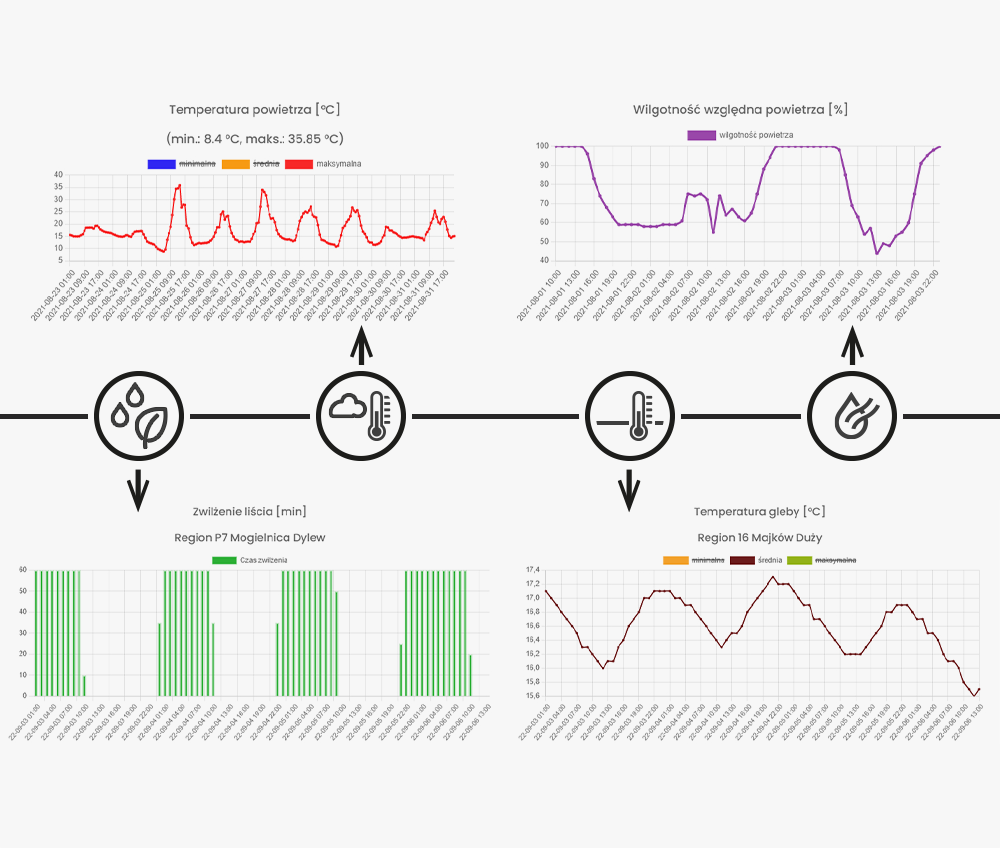
Data from the weather station's sensors, m.in: air temperature, soil temperature, relative humidity, precipitation and wetting time of the "artificial leaf" surface, are collected on the Farm Smart platform. Then, the collected data are superimposed on disease models that indicate the level of risk of infection (no threat, low threat, warning, alarm, i.e. high risk). This allows you to automatically generate alerts to warn you of the possibility of a threat.

The higher the percentage of the threat, the higher the risk of infection. The level of severity of plant infection by the pathogen depends on the length of the period of high risk of infection, the amount of pathogen in cultivation and the sensitivity of the variety or the development stage of the plant to the causative agent of the disease.

The information from the Farm Smart system allows you to perform the protective treatment at the optimal time and make an informed decision whether to perform the treatment or not to perform it. This allows you to eliminate excessive, unnecessary use of plant protection products.

Pest monitoring – how does it work?

Monitoring carried out with the use of pheromone and colour traps allows us to track the number and dynamics of occurrence of individual pest species in selected regions of the country. Based on the uploaded photos from the traps, the system automatically identifies and counts insects. Thanks to the collected information, it is possible to determine the level of threat (none, medium or high threat) by the current pest species, forecast the appearance of larvae or caterpillars and signal the appropriate time to combat them.

SMS messages about an emerging threat from the malware are compiled by experts based on daily photos and data from traps.

Pest signaling is also carried out on the basis of data from meteorological stations (m.in. air and soil temperature, air humidity) and the values of effective temperature sums (STE) from phenological models of pest development. Thanks to this, it is possible to forecast the date of appearance of a given pest species in the crop.

Meteorological Data

Access to current and historical data from the nearest weather station.  The system displays data from each sensor that has been connected to the station, including air temperature and soil temperature, relative air humidity, amount of rainfall, leaf wetness time, as well as other parameters such as the Delta T indicator, which refers to water evaporation rate and is one of the main parameters determining the optimal conditions during spraying.

Weather Forecast

7-day weather forecast:
  • Temperatura powietrza (°C)
  • Prawdopodobieństwo wystąpienia opadów (mm)
  • Wilgotność względna powietrza (%)
  • Okno oprysku – wskazujące optymalne warunki atmosferyczne do wykonania zabiegu ochronnego
    • Zielone okno: odpowiednie warunki atmosferyczne do wykonania zabiegu ochronnego
    • Czerwone okno: niesprzyjające warunki (stosowanie zabiegów ochronnych niezalecane)
  • Współczynnik ewapotranspiracji Eto (mm) – całokształt procesów związanych z odpływem do atmosfery wody parującej z powierzchni gleby (ewaporacja) pokrytej roślinnością (transpiracja)
  • Zachmurzenie (%)
  • Prędkość i kierunek wiatru (m/s)

Disease infection forecasting

PWe forecast the possibility of the occurrence of disease infections in the following days.

An innovative prediction system which, on the basis of developed disease models and detailed weather forecasts, predicts the possibility of a disease infection several days in advance. This feature allows for better management and planning of future treatments.

Field manager

Crop Management

The system allows you to define crops on each plot and to record all treatments carried out in a given field.

Field card

Possibility of collecting all information about a given tillage area. The system allows you to define multiple field cards in one season, which is helpful when you have several different tillage areas with a short growing season within the same field. When defining a tillage area, you can specify the type of crop, additional crop, catch crops, and whether it is organic or conventional. Based on this information, the system automatically suggests e.g. plant protection products registered for this tillage area, etc. The field card has a defined start date and an expected end date, on the basis of which it is possible to assign treatments to specific field cards, also automatically using Tracky and mID devices.
Treatments

Possibility of recording all agrotechnical procedures, from cultivation and sowing or planting all the way through to harvesting. For each treatment, it is possible to assign the materials used, such as plant protection products, fertilisers or seeds.